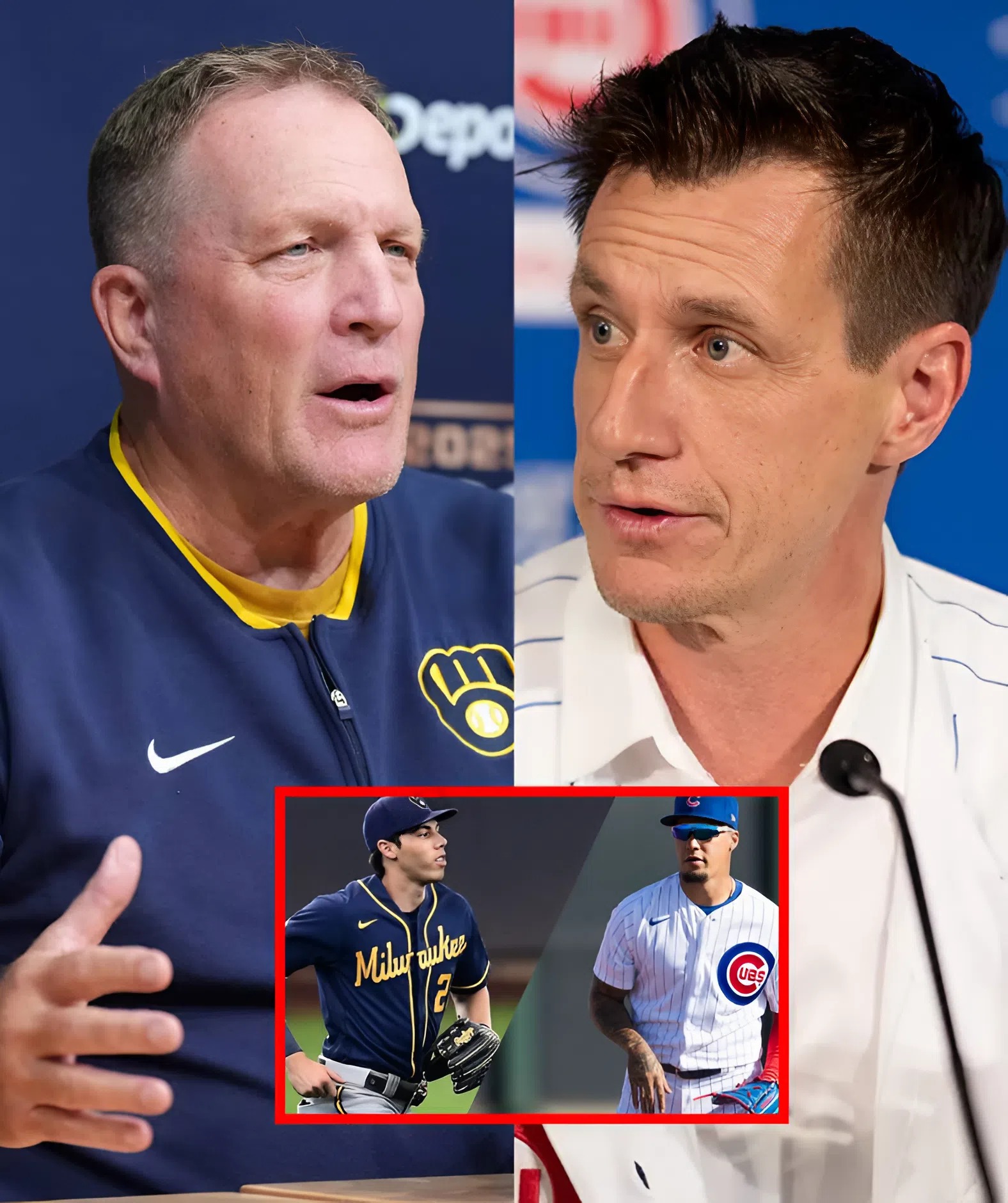
Pat Murphy’s Honest Admission After Cubs’ 12–0 Dominance Reveals Why Craig Counsell’s Leadership Is Changing Chicago
The final score at Wrigley Field told one story. Chicago Cubs 12, Milwaukee Brewers 0. A decisive, one-sided result that left little doubt about which team controlled the game from the first inning to the last.
But after the game ended and the clubhouse lights began to dim, Milwaukee Brewers manager Pat Murphy offered a perspective that went far beyond the scoreboard.
His words were not about a single game, a hot night at the plate, or a pitching staff that refused to give Milwaukee any breathing room. Instead, Murphy spoke about something deeper—something he believes is shaping the Cubs into a far more dangerous force than many observers realize.
And in doing so, he pointed directly to the man leading the team: Craig Counsell.
For most fans, Chicago’s performance looked like a simple case of overwhelming talent. The Cubs lineup produced runs early and often, their pitchers dominated every inning, and the Brewers never managed to establish momentum.
But Murphy made it clear that what he saw from the opposing dugout told a different story.
“People look at Chicago and see talent—elite players, big moments, top-level performances,” Murphy said after the game.
Then he paused before continuing.
“But from my perspective, as a coach and as an opponent… it’s more than that.”
Murphy has spent decades inside professional baseball. He understands that talent alone rarely produces consistency. Teams built only on individual ability often struggle when pressure rises or when a season grinds into its most difficult months.
What he sees in Chicago, however, is something else entirely.
“This team isn’t just talented—it’s built with clear purpose,” Murphy explained.
According to the Brewers manager, the Cubs are playing with a level of organization that separates them from many teams across Major League Baseball.
“There’s leadership. There’s structure. There’s a system that works efficiently, shift by shift,” he said.
Murphy emphasized that the Cubs’ execution did not appear random. Every defensive alignment, every pitching decision, every offensive adjustment looked deliberate.
That kind of coordination, he suggested, rarely happens without strong leadership from the top.
“And that comes from the head coach,” Murphy added.
The praise carried additional weight given the history between Murphy and Counsell. Counsell himself previously managed the Brewers before taking the Cubs job, meaning Murphy knows exactly how the Chicago manager thinks, prepares, and leads a clubhouse.
From Murphy’s viewpoint, the Cubs’ performance was not just the product of a single strong roster.
It was the product of a manager who knows how to turn talent into something greater.
“Craig Counsell doesn’t just coach talent—he elevates it,” Murphy said.
The comment reflects a belief that many around baseball have begun to share. Since taking over in Chicago, Counsell has focused on creating a system where players understand their roles clearly and perform with confidence inside that structure.
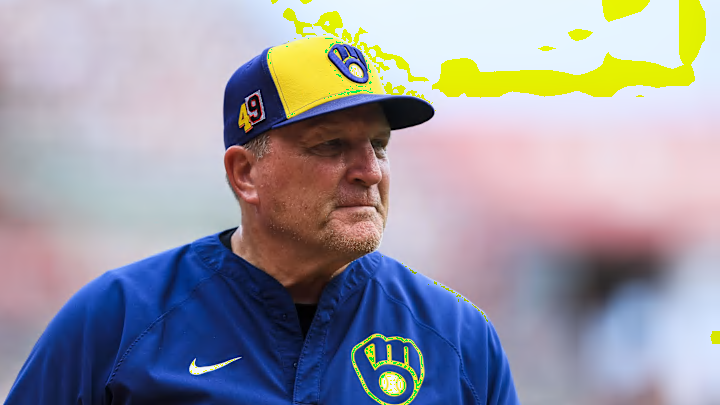
Rather than forcing players into rigid molds, Counsell has built an environment where individual strengths are amplified.
For hitters, that means preparation and discipline at the plate. For pitchers, it means clear game plans and defensive support behind them. For the clubhouse, it means accountability paired with trust.
The result, at least on nights like this one, is a team that plays with remarkable clarity.
From the opening inning against Milwaukee, Chicago set the tone. Aggressive swings at the right pitches led to early runs. The pitching staff attacked the strike zone. Defenders moved confidently, rarely appearing out of position.
By the middle innings, the outcome was already leaning heavily in Chicago’s favor.
Yet Murphy’s comments suggested that the result was not surprising.
In fact, he implied that this version of the Cubs might be exactly what Counsell has been building toward since the beginning.
Opposing managers often hesitate to offer too much praise after difficult losses. Baseball culture tends to reward restraint and quiet respect rather than public admiration.
Murphy, however, did not hide what he believed he had witnessed.
After describing Chicago’s organization and leadership, he paused again before delivering a final summary of Counsell’s impact.
Then he described the Cubs manager’s leadership in exactly fifteen words:
“A leader who transforms talent into purpose, preparation into confidence, and teams into relentless competitors.”
Those words captured something that numbers cannot always measure.
Statistics will record the Cubs’ twelve runs and Milwaukee’s zero. They will track hits, strikeouts, and defensive plays.
But Murphy’s message focused on the foundation behind those numbers.
In his eyes, Chicago is not simply winning games because of strong individual performances.
The Cubs are succeeding because they have built a culture where preparation meets execution.
![Phân tích MLB] Huấn luyện viên Cubs Craig Counsell nhấn mạnh việc khiến Roki Sasaki "vướng vào rắc rối" trong trận thua thứ hai trước Dodgers : r/CHICubs](https://external-preview.redd.it/mlb-analysis-cubs-manager-craig-counsell-highlights-putting-v0-TJga4ENZjaIGIWnMrVTR7aDftICwagsUHDHgHahlhMs.jpg?width=640&crop=smart&auto=webp&s=b4d744612ae3fcb07e3649028469da321478be1a)
That culture starts with leadership.
For Chicago fans, the comments from a division rival may feel especially meaningful. Praise from inside the same clubhouse is expected. Praise from an opponent who just lost by twelve runs carries a different level of authenticity.
Murphy’s remarks suggest that the Cubs are earning respect across the league—not just for what they accomplish on the field, but for how they operate behind the scenes.
And if his observations are accurate, Chicago’s dominant night against Milwaukee may represent more than just a single victory.
It may represent the visible result of a system quietly taking shape.
A system where players understand their roles.
A system where preparation leads to confidence.
And a system led by a manager who believes talent alone is never enough.
For Craig Counsell, that philosophy appears to be turning potential into performance.
For the Cubs, it may be turning a talented roster into something far more dangerous for the rest of Major League Baseball.