Leadership Revealed in the Hardest Moments: How Caleb Williams’ Words Signal a New Era for the Chicago Bears
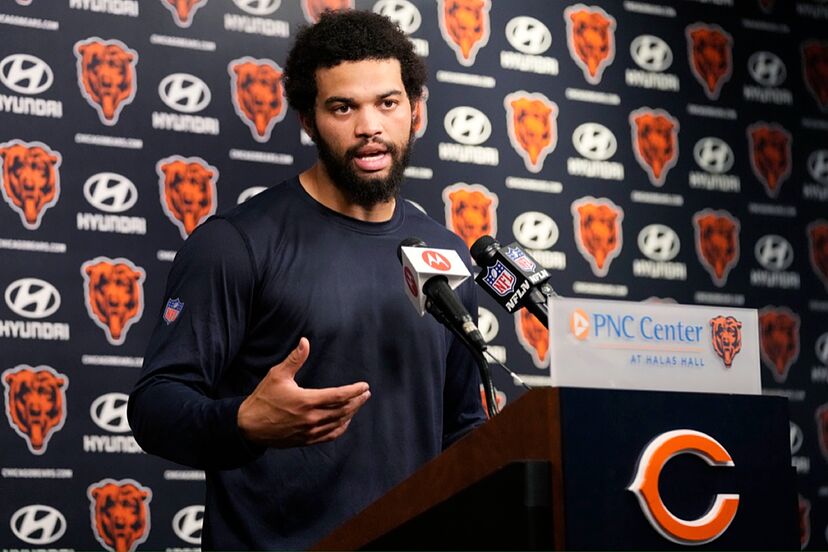
In professional sports, leadership is often measured by wins, statistics, and trophies. Quarterbacks are praised when the scoreboard favors them and scrutinized when it does not. Yet the truest test of leadership rarely comes after a triumphant Sunday. It comes in the quiet aftermath of a difficult season, when frustration is high, expectations have not been met, and excuses are readily available.
That is why Caleb Williams’ recent words about teammate Colston Loveland deserve far more attention than a routine postgame quote. “He works hard, listens, and never complains — that’s truly rare,” Williams said. The timing of the comment is what makes it powerful. It was not delivered after a victory parade or a breakout performance. It came after a challenging season, one that tested the Chicago Bears both on the field and within the locker room.
For a franchise that has spent years searching for stability at quarterback and identity as a team, this moment matters.
The Context Matters More Than the Quote
NFL history is full of soundbites. Players praise teammates all the time, often out of habit or obligation. What separates Williams’ statement from the noise is the context surrounding it. The Bears are not coming off a dominant year. The season was marked by inconsistency, learning curves, and growing pains that are inevitable for a young roster and a developing quarterback.
In moments like these, it is easy for a quarterback to point to circumstances. Offensive line struggles, injuries, play-calling debates, or the pressure of unrealistic expectations can all become convenient explanations. Many players choose silence. Others choose deflection.
Williams chose acknowledgment.
By highlighting Loveland’s work ethic and attitude, Williams subtly redirected the narrative. Instead of focusing on what went wrong, he focused on what was done right behind the scenes. That choice reflects maturity, awareness, and an understanding of what leadership actually looks like in the NFL.
Why Praising Teammates After Struggle Is Rare

Winning teams create natural harmony. Losing seasons expose fault lines. When adversity strikes, egos become louder, patience grows thin, and accountability is often selective. In that environment, praise becomes scarce because it requires humility.
For a quarterback, especially one viewed as a franchise cornerstone, public comments carry weight. Every word is dissected by fans, media, and teammates alike. Choosing to elevate a teammate after a tough year sends a message that resonates far beyond a single quote.
It tells the locker room that effort matters, even when results fall short. It tells young players that their professionalism is seen and valued. Most importantly, it tells the organization that leadership is not being deferred until success arrives. It is being practiced now.
What This Says About Caleb Williams
Leadership in the NFL is often confused with volume. The loudest voice in the room is not always the strongest. Williams’ statement reveals a different style — one built on observation, respect, and perspective.
Rather than centering himself, Williams shifted attention to a teammate who embodies the traits coaches preach but do not always see consistently executed. Hard work. Listening. Emotional control. No complaints. These are not glamorous qualities, but they are foundational.
For a young quarterback navigating the pressure of expectations in Chicago, this approach suggests long-term thinking. Williams understands that success is built through culture before it is reflected in standings. That understanding is critical for a franchise that has cycled through resets for far too long.
Colston Loveland and the Quiet Backbone of a Team
Loveland’s role in this moment is equally important. Players like him rarely dominate headlines. They do not always fill stat sheets or trend on social media. Yet every successful team has a core of individuals who stabilize the environment through consistency and professionalism.
By calling out Loveland specifically, Williams gave fans and analysts a glimpse into the internal dynamics of the Bears. It is a reminder that progress is not always visible on Sundays. Sometimes it happens in practice, in meetings, and in the way players respond when things are not going their way.
Those players become the backbone of rebuilding teams. They set standards when external validation is absent. And when success eventually comes, they are often the reason it is sustainable.
A Signal to the Locker Room and the League
Words spoken publicly echo privately. Teammates hear them. Coaches notice them. Opponents eventually feel them.
Williams’ comment sends a clear signal to the Bears locker room: accountability and effort will be recognized, regardless of circumstances. That message encourages buy-in, especially among younger players still learning how to navigate the professional level.
It also sends a quieter message to the rest of the league. Chicago’s future is not being built on excuses or entitlement. It is being shaped by players who understand that adversity is part of the process, not a reason to abandon it.
Why This Moment Feels Different for Chicago

Bears fans are no strangers to patience wearing thin. Promising starts have fizzled before. Leadership transitions have felt incomplete. The idea of “turning the corner” has been repeated so often that it has lost meaning.
What makes this moment different is its subtlety. There is no bold proclamation. No guarantee of immediate success. Just a quarterback choosing character over deflection at a time when deflection would be easy.
Those moments are rarely celebrated, but they are often remembered later, once a team finds its footing. In hindsight, they become the early indicators that something real was forming beneath the surface.
Leadership Before the Wins
The NFL rewards results, but it is sustained by habits. Teams that build leadership only after winning often struggle to maintain it. Teams that establish leadership during hardship give themselves a chance to grow into something lasting.
Caleb Williams’ words may not change a record or silence critics overnight. But they do something more important. They reinforce the idea that leadership is not postponed until success arrives. It is revealed in how players respond when success is absent.
For the Chicago Bears, that distinction matters. It suggests that the foundation is being laid not in celebration, but in resilience. And for a franchise searching for its next true era, that may be the most encouraging sign of all.